AFGHANISTAN EVACUATION RESEARCH PROGRAM (2021-2024)
This archive documents my role in crisis‑time coordination during the U.S. withdrawal from Afghanistan and the subsequent three‑year research program that informed congressional oversight and executive‑branch accountability
Background
I joined Veterans for American Ideals because I believed in something simple: America keeps its promises.
When we ask people to risk their lives for our missions, we owe them safety when the mission ends. It's not charity. It's not politics. It's who we said we were.
But I also believed in something bigger: that refugees and immigrants don't just need us—we need them. New perspectives. New ideas. The innovation that drives our economy and strengthens our society.
For three years, I advocated to Congress and the White House to bring more refugees, honor the SIV commitments, and live up to the promise.
When I joined the Association of Wartime Allies in 2019, we were tracking something most people weren't paying attention to: a growing backlog of 81,000 Afghan allies stuck in the Special Immigrant Visa process.
Translators who'd served on the front lines. Advisors who'd shaped strategy. Women who'd built schools and defended human rights.
All waiting. All in danger. All holding onto a promise we'd made.
Then Kabul fell. In 72 hours, everything we'd feared became real.
I was on the phone with people trapped outside Hamid Karzai International Airport. Families crushed in crowds. Taliban checkpoints blocking the routes. The clock running out.
The U.S. government was overwhelmed. The data systems were fragmented. Nobody had a complete picture of who was where, who had paperwork, who could get through. So we became the coordination layer.
I spent August 2021 matching names to manifests. Cross-referencing paperwork. Getting people over the wall at HKIA.
And I had to make decisions I'll carry for the rest of my life: Who gets on the list. Who doesn't.
A woman whose husband was killed by the Taliban, does she have the right documents? A translator who saved American lives but lost his paperwork in the chaos, can we verify his service fast enough? A family of six at the gate, can they all fit on this flight, or do we split them up?
Every decision was someone's life. We got thousands out. But 78,000 were left behind.
When the last plane left on August 31st, most people moved on. I couldn't.
Because I knew their names. I had their phone numbers. I'd told them: We're coming for you.
And then we didn't.
So I did the only thing I knew how to do: document what happened to them.
Over 24 months, we surveyed 20,000+ people still in Afghanistan. We tracked them as the Taliban hunted them. As they lost jobs, went hungry, watched their children suffer.
We documented:
30% imprisoned by the Taliban
88% who lost their jobs
70% who went without food
98% of women who lost all economic opportunity
138 cases of targeted killings
85 cases of torture
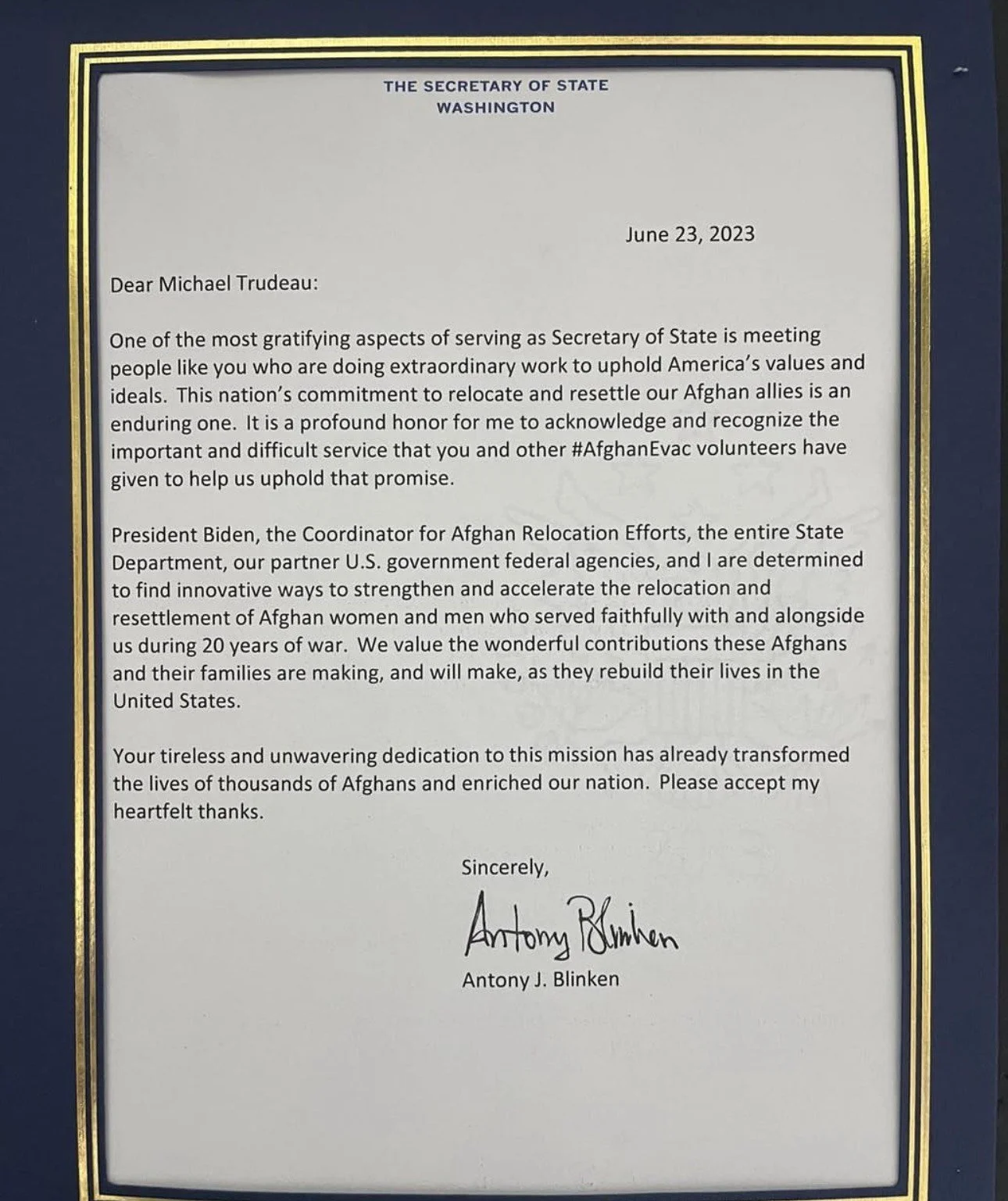
We published four quarterly reports. We gave Congress the data. We told the story the numbers alone couldn't tell. The work was cited in congressional oversight. The Secretary of State sent a formal recognition.
But the numbers kept getting worse.
Why This Still Matters
Three years later, most of those 78,000 are still there. Still hiding. Still hoping we'll remember the promise we made.
I continue this work because broken promises have consequences:
For them: Every day in hiding is another day closer to being found. Another day their children go without education. Another day the trauma deepens.
For us: Every ally we abandon is a message to the next generation: Don't trust America. Don't help American forces. The promise isn't real.
For our future: When we turn away the people who risked everything for our values, we don't just lose allies, we lose the innovation, the perspective, the human capital that makes America stronger.
What I Learned
You can't outsource moral responsibility.
In August 2021, making decisions about who gets on the list, I couldn't defer to policy or process. I had to decide. And live with it.
That experience taught me something about leadership in crisis:
You build systems when you have time. You make judgment calls when you don't.
Perfect information never comes. You decide with what you have.
The people depending on you don't care about your constraints. They care about your character.
These lessons show up in everything I do now, building platforms under pressure, coordinating distributed teams, making time-bound decisions with incomplete information.
Reports
OVERVIEW
I Led a 3 year research program documenting conditions for 20,300+ Afghan SIV applicants (representing ~91,350 people) left behind after U.S. withdrawal.
Published 4 quarterly reports featuring:
Original survey research (20,500 respondents per wave)
Longitudinal tracking and trend analysis
First systematic documentation of gender-based persecution under Taliban
First documentation of veteran moral injury from evacuation
Targeted killing and torture documentation
Evidence-based policy recommendations
IMPACT
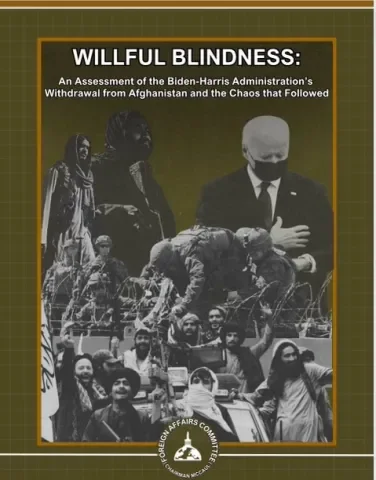
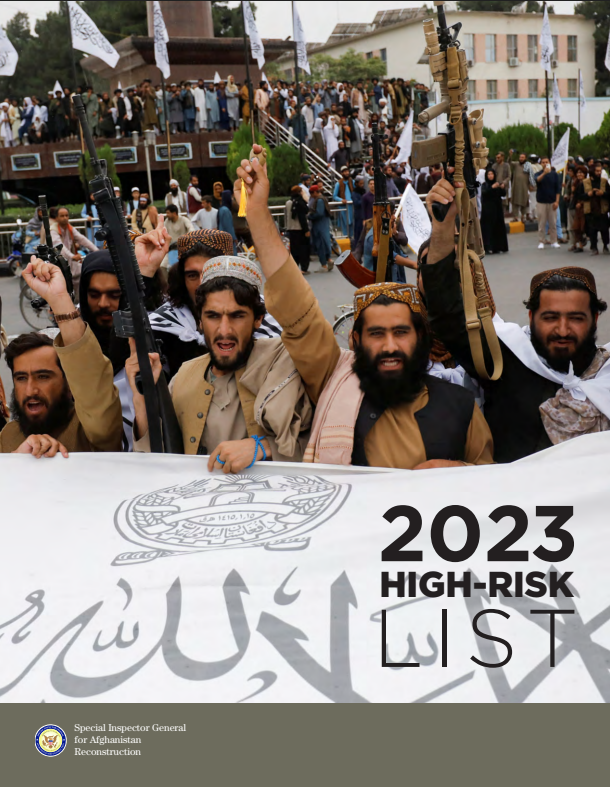
Cited in congressional oversight (SIGAR, House Foreign Affairs Committee)
Informed Afghan Adjustment Act legislative discussions
Recognized by U.S. Secretary of State (June 2023)
Provided evidence base for ongoing advocacy and policy work
April 2023 - AWA Quarterly Report (in partnership with the Iraq and Afghanistan Veterans of America)
This report documents the scale of the Special Immigrant Visa crisis facing Afghan allies after the Taliban takeover, and the downstream moral injury experienced by the veteran community.
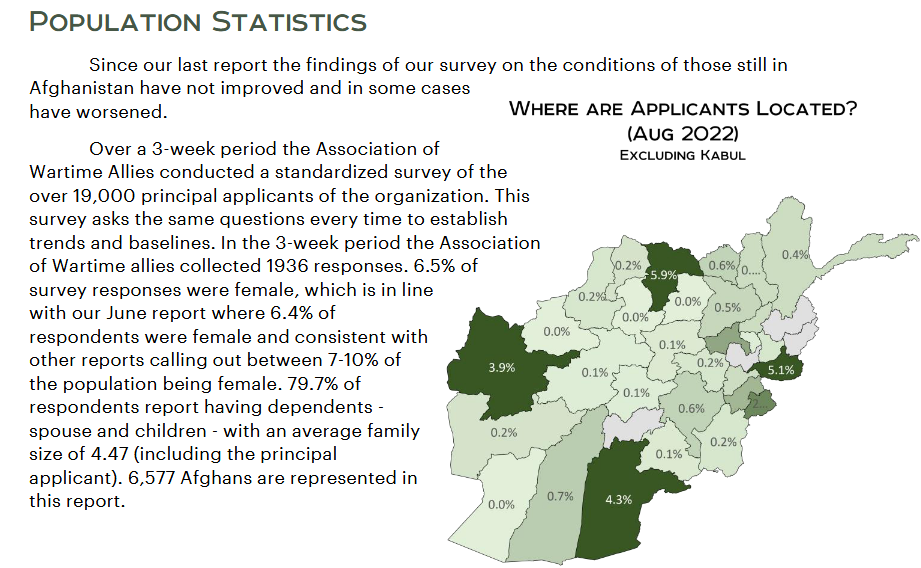
August 2022 - The Left Behind Afghans - One Year Later
The report coincides with the one-year anniversary of the Non-Combatant Evacuation Operation (NEO) conducted in August 2021, during which 124,000 people were evacuated (76,000 to the United States directly).
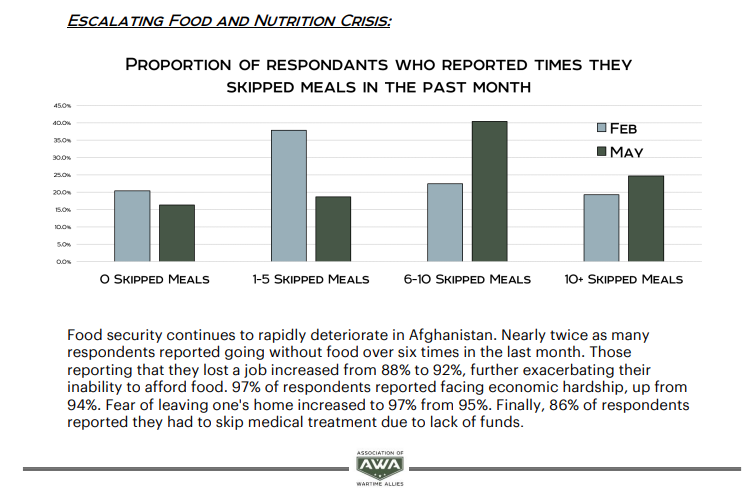
June 2022 - The Left Behind Afghans - Focus on Women
This report has a specific emphasis on the gender-based persecution and hardship faced by Afghan women who worked with the U.S. mission.
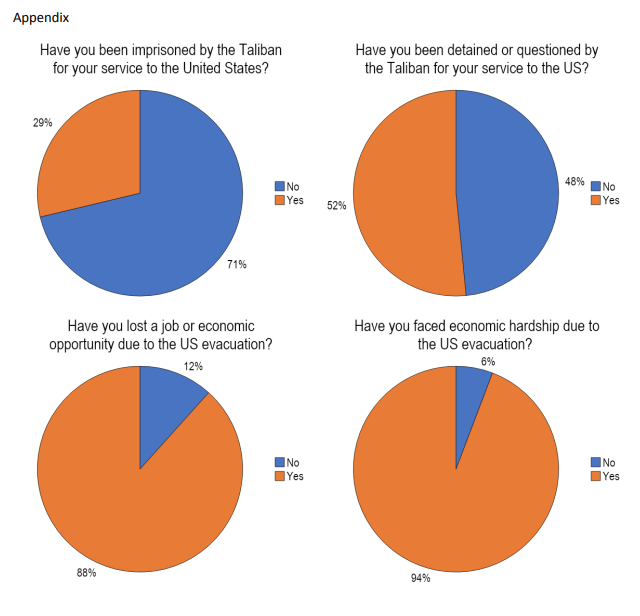
February 2022 - The Left Behind Afghans
This was the first report in AWA's series, published six months after the U.S. evacuation from Afghanistan.
Official Report Works Cited